
Hawthorne Wood Flooring installs wide plank hardwood flooring in Hawthorne, CA, serving surrounding cities including Del Aire, Lennox, Alondra Park, Lawndale and West Athens, along with herringbone and chevron pattern floors. Over more than 20 years we have learned that these are the floors where preparation shows most, because a wide board magnifies every bit of movement and a pattern floor magnifies every error in layout.
Both styles are popular for good reason. Wide planks show off long runs of grain and make a room feel calmer, while herringbone and chevron add movement and a sense of craft. Both also cost more than standard strip flooring, which makes it more important that the floor is planned to last.
Before we order material, we test moisture in the subfloor or slab, check flatness and discuss whether solid or engineered construction suits your house. Those decisions are what keep a wide or patterned floor looking the way it did on the first day.
Wide Plank Floors
Why Wide Boards Need a Stable Base
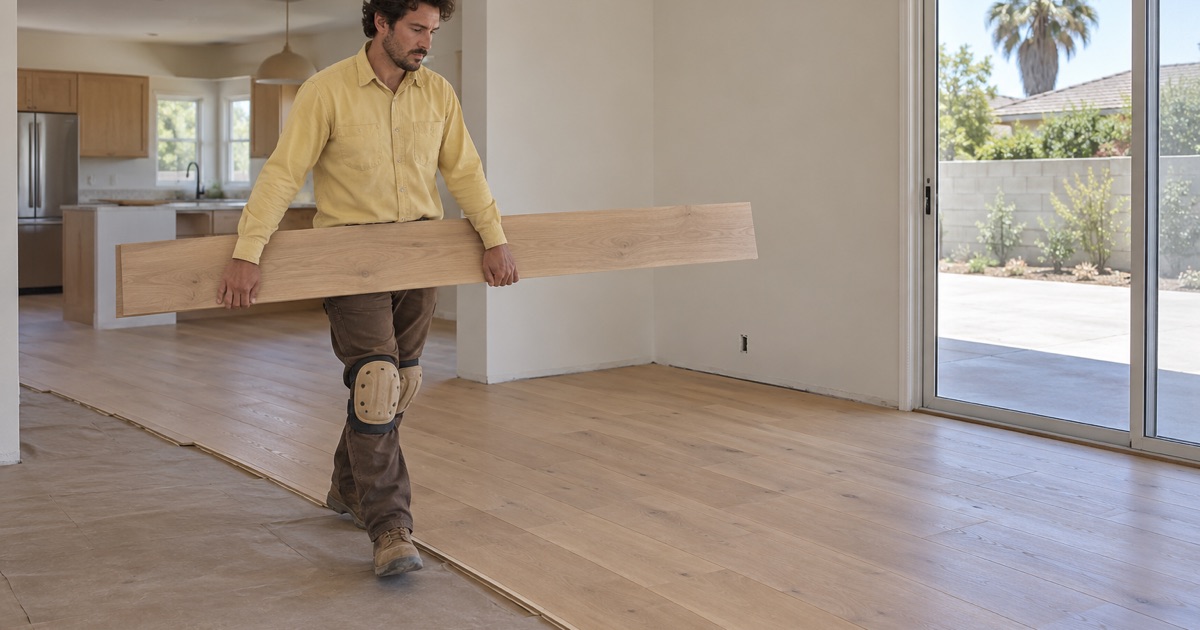
Wood expands and contracts across its width as humidity changes. On a narrow strip the movement is small, but on a nine-inch board it can open visible gaps in dry weather or cause cupping in damp weather. A flat, solid subfloor and wood installed at the right moisture content keep that movement within normal limits.
We check the subfloor with a long straightedge and correct high and low spots before installation. A wide board bridging a dip will rock and squeak, and on a glued floor it can leave a hollow spot under the plank.
Solid Against Engineered Wide Plank
Solid wide plank floors have a traditional feel and can be sanded many times. Engineered wide planks use a real wood top layer over a cross-laid core that resists movement, which makes them the safer choice over a concrete slab and in rooms with humidity swings. For many houses in this area, engineered construction is what makes wide boards practical.
When comparing engineered products, we look closely at the wear layer thickness. A thicker layer means the floor can be sanded and refinished in the future, which matters more for a premium wide plank floor you plan to keep.
White Oak and Other Wide Plank Species
White oak is the most requested species for wide plank floors, for its straight grain, even stain uptake and hardness. Hickory offers dramatic color variation and greater hardness on the Janka scale. Walnut gives a dark, rich look but dents more easily. We show you full-length samples, since grain looks different on a wide board than on a small chip.
Herringbone and Chevron Patterns
Laying Out From a True Center Line
A pattern floor starts with layout, not with the first board. We find the true center of the room or the main sightline, snap reference lines square to it and dry-lay the pattern to see how it will meet each wall and doorway. Rooms are rarely square, so the pattern is centered on what the eye sees rather than on one crooked wall.
This is the step that separates a professional pattern floor from a disappointing one. A herringbone laid off a wall that runs out of square drifts across the room until the last rows are visibly skewed.
Herringbone Against Chevron
Herringbone boards are rectangles laid in a staggered zigzag, with the end of each board meeting the side of the next. Chevron boards are cut at an angle so their ends meet in a continuous V. Herringbone gives more texture and hides small variations in the room, while chevron has a cleaner, more formal line.
Both patterns can be laid in solid or engineered wood and in a range of board sizes. Smaller boards make a busier pattern suited to larger rooms, while longer boards give a bolder look that can make a small room feel bigger.
Borders, Transitions and Doorways
Pattern floors often look best framed with a border of straight boards around the room, which also makes it easier to handle out-of-square walls. At doorways, we plan where the pattern stops and how it meets the adjoining floor, using a reducer strip or T-molding where heights differ.
Where a pattern runs from room to room without a door, we usually carry it through unbroken so the floor reads as one space. Where it has to stop, a straight-laid threshold board or a border gives the change a deliberate edge instead of an awkward cut line across the zigzag.
Installation Methods for Wide and Pattern Floors
Glue-Assist and Full Glue-Down
Wide solid planks are often installed with both nails and adhesive, which helps hold the boards flat. Over a slab, wide engineered planks and pattern floors are usually fully glued down. We use adhesives the manufacturer approves and trowel them at the specified coverage, so every board is fully bonded rather than resting on a few ridges of glue.
Over a plywood subfloor in a raised-foundation house, many herringbone floors are glued and pinned piece by piece. Each board is short, so each one needs to be fixed securely on its own, and we check the subfloor for flatness and loose sheathing before we start because a pattern shows any dip immediately.
Finishing a Pattern Floor on Site
Unfinished herringbone and chevron floors are sanded and finished after installation. Because the grain runs in two directions, we sand at an angle and finish with an orbital sander to remove cross-grain marks. We then apply stain and finish products that meet the South Coast air district’s VOC limit for wood coatings.
Site finishing also lets you choose the final color on the installed floor. We lay stain samples on the sanded pattern and look at them at different times of day, since the two grain directions in a herringbone catch light differently and can make one stain look like two shades.
- 20+ Years With Wood Floors
- Written, Itemized Estimates
- Low-VOC South Coast Finishes