
Hawthorne Wood Flooring provides water damaged hardwood floor repair throughout Hawthorne, CA, serving surrounding cities including Del Aire, Lennox, Alondra Park, Lawndale and West Athens. Over more than 20 years we have repaired floors soaked by burst supply lines, failed water heaters, dishwasher leaks, overflowing tubs and water that came through the ceiling from the unit upstairs.
Water damage in a wood floor is rarely as small as the stain that shows. Water runs along the seams and under the boards, soaks into the subfloor and can travel into the next room before anything is visible on the surface. We start by tracing the water to its source and mapping how far it spread with a moisture meter, so the repair covers the whole affected area rather than just the part you can see.
We also know that most water-damage repairs involve more than one party. An insurance adjuster, a landlord, a building association or a neighbor may all need to see what happened. Our photos, dated moisture readings and itemized scope are written so each of them can use the same record.
Finding the Source and the Spread
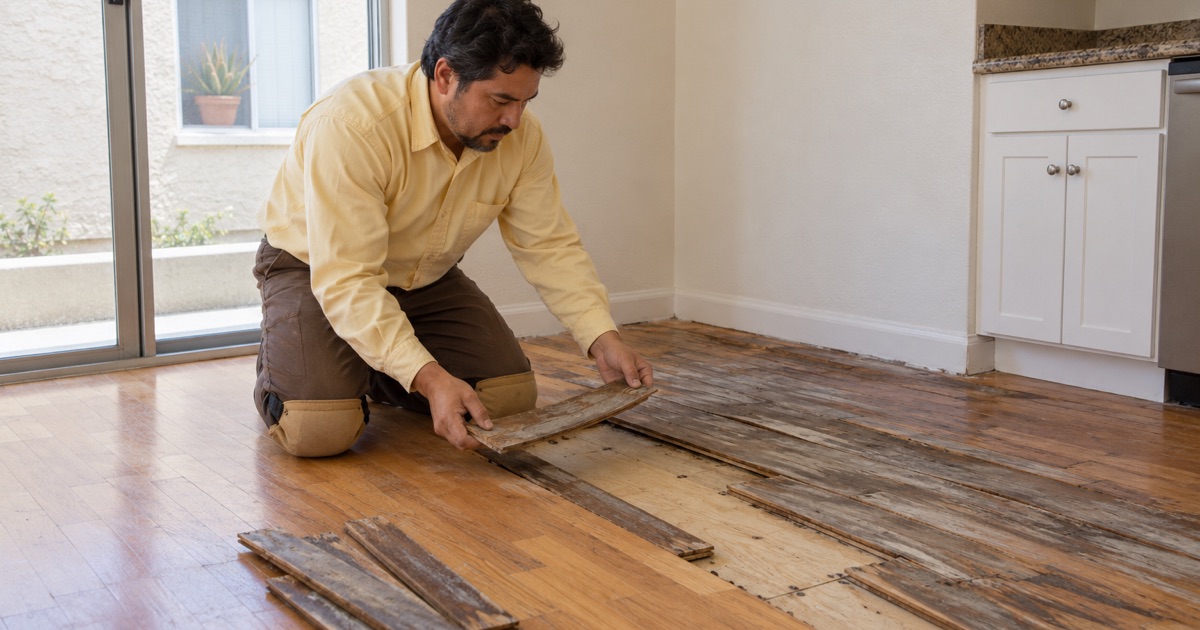
Tracing the Leak Before Anything Is Removed
The first question is always where the water came from and whether it has stopped. A supply line or water heater is usually obvious, but slow leaks from a toilet seal, a shower pan or a drain line can run for months. In multi-unit buildings, water often arrives from above, following pipes and framing before it reaches the floor.
Nobody should start removing boards until the source is fixed. Drying a floor that is still being fed by a leak wastes time and money, and it makes it harder to show later how the damage happened.
Mapping Moisture Across the Floor
We take readings across the wet area and well beyond it, in the finished boards and in the subfloor where we can reach it. Readings from rooms that stayed dry give us the target the wet floor needs to return to. The map shows the edge of the damage, which is often a surprise to owners who only saw a small puddle.
That map becomes part of the written record. It shows which boards were wet, how wet they were and when, and it lets us confirm later that the floor has actually dried rather than guessing from how it looks.
Photos and Records for the Adjuster
An insurer reviewing a flooring claim wants to see the source, the extent of the damage and the condition of the floor before the loss. We photograph each of those, note the date and time on every reading and write a scope that separates new water damage from existing wear. A clear record makes the claim easier to review.
Saving or Replacing the Wet Boards
When a Wet Floor Can Be Saved
Solid hardwood that was wet for a short time, over a subfloor that can breathe, often dries back close to flat. Air movers, dehumidifiers and panels that draw moisture from the boards are usually set up by a water mitigation company, and we take readings regularly until the wood is near the moisture content of the dry rooms.
Patience matters here. Boards that look cupped during drying often flatten as they reach balance, and sanding too soon cuts off wood that would have settled back, leaving the floor crowned once it fully dries.
Boards That Have to Come Out
Some boards cannot be saved. Wood that has turned black from water reacting with the tannins in oak, boards that cracked as they swelled, engineered planks whose core has delaminated and any wood with mold growth are replaced. We remove only those boards where possible, keeping sound flooring in place.
When a floor has buckled off the subfloor, removal is usually wider. We lift the affected rows, check the fasteners and the sheathing, and set aside undamaged boards that can be reinstalled after the area is dry.
Matching New Boards to the Old Floor
Replacement boards need to match species, width, thickness and, after finishing, color. For common oak floors that is usually straightforward. For older, discontinued or site-finished floors it can be difficult, and when a close match is not possible we document why, since matching often shapes how much of the floor an insurance claim covers.
The cleanest result often comes from refinishing the whole room once the repair is in. A single finish over old and new boards removes the color difference that makes a patch visible.
The Subfloor Under a Wet Floor
Plywood That Swelled or Delaminated
Plywood and particleboard underlayment hold water long after the boards above have dried. They swell, lose their glue bond and weaken. We check the subfloor wherever boards come up, replace any sheathing that has delaminated or softened, and make sure every new panel edge is supported before the floor is laid back over it.
Skipping this step is the most common reason a repaired floor starts squeaking or gives underfoot a few months later. The finished floor is only as solid as the layer it is fastened to.
Mold, Odor and Sanitation
Water that sits under a floor for days can support mold, especially in a closed crawlspace or under a floating floor. Water from a sewer line or toilet overflow also raises sanitation concerns. Where we find mold or contaminated water, we recommend the appropriate specialist before any flooring work begins, rather than covering it with new boards.
A lingering musty smell after a floor looks dry is a warning sign worth taking seriously. It usually means moisture is still trapped in the subfloor or the wall cavity, and it is far cheaper to open a small area and check than to refinish a floor and then pull it up again.
Water Damage in Rentals and Multi-Unit Buildings
Leaks From the Unit Upstairs
In apartments, condos and duplexes, the floor that is damaged is often not in the unit where the leak started. We photograph the ceiling as well as the floor, note the path the water took and share the same record with every party involved, so the owner, the association and the insurers are working from one set of facts.
Getting a Rental Back on the Market
A water-damaged rental unit is a unit that is not earning rent. We schedule the repair around the dates the owner needs, and our itemized invoices show exactly what was repaired and why. If a tenant caused the damage, that record also supports an accurate itemized statement of deductions under California deposit law.
- 20+ Years With Wood Floors
- Written, Itemized Estimates
- Low-VOC South Coast Finishes